Showing posts with label Design. Show all posts

Thursday, 20 March 2014

Design in Nature

Design in Nature by James Ritchie (1937)
"It is a strange thing that if the onlooker wishes to understand the ways of living things he must look beyond the living creature itself to the environment in which it lives. For life is sensitive, and the forces of nature have played upon living things for so long a time - millions and millions of years - that they have impressed patterns upon the lives of plants and animals.

But the patterns are not visible at first glance; and one of the objects of this book... is to explain in simple language the ways in which the living world has been moulded by some of the forces of inanimate nature - the all-prevailing influence of the sun, the succession of the seasons, the rhythm of day and night.

Study any example you like - here for variety we have taken as examples, life in a wasp's nest, the spring migration of birds, the significance of song, life in a pond, and so on, and the impression grows that an understanding of the lives of plants and animals can be gained only through an understanding of the designs which the rhythms of nature have imposed upon them. As well as these, some other relationships which contribute to the final pattern of nature are discussed here."


James Ritchie (1882–1958) was born at Port Elphinston, Aberdeenshire and educated at Robert Gordon's College and the University of Aberdeen before joining the staff of the Royal Scottish Museum in 1907 to become Keeper of the Department of Natural History in 1921. His interests were for the whole of the animal kingdom but especially birds. He had a major influence in legislation dealing with the protection of grey seals and wild birds. His book 'The Influence of Man on Animal Life in Scotland: A Study of Faunal Evolution' (1920) brought international recognition. The work encouraged the growth of the study of animal ecology and of its application in conservation. Ritchie influenced the establishment of the Nature Conservancy Council with its separate organisation in Scotland.

Wednesday, 26 February 2014

Fitness: Stats February 2014


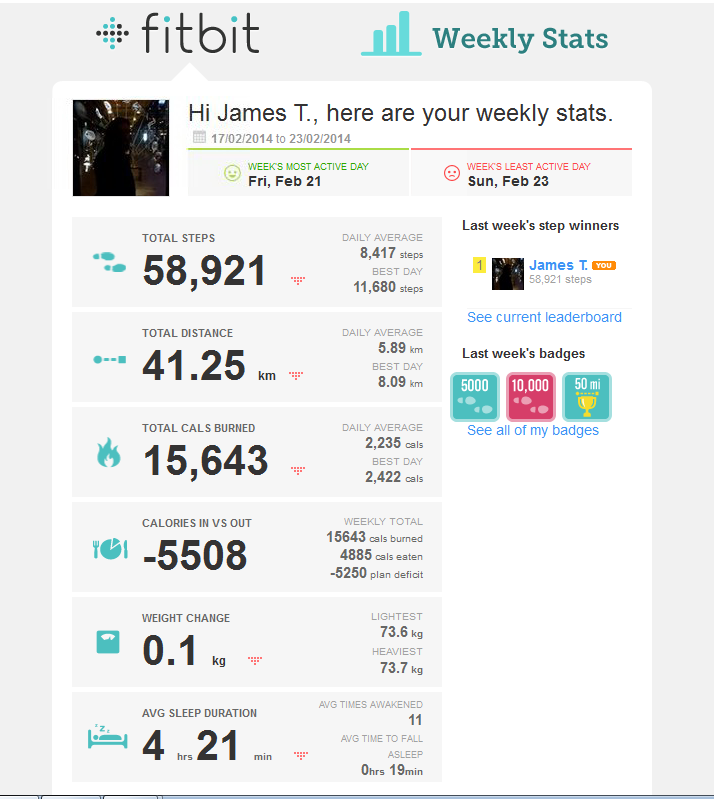
The automatic monitoring facilitated by my Fitbit flex and the Fitbit online dashboard application is delivering some really useful information. I'm trying to feedback this into my actions to improve my results through evaluation and tweaking (apply self-regulation and accept feedback). All of the stats above appear to be good renderings of reality, apart from...  
  • Calories In vs Out (the Calories In bit is not automated and requires me to enter all the food items I consume and record their nutritional information, this is not always easy to do, when I do it - and it's an area that I don't always do - it's easy to forget or overlook as it's time consuming and fiddly).
  • Sleep Duration (the Fitbit records movement in my sleep as time awake, my subjective take is that it may well reflect restlessness but generally doesn't reflect a wakeful state)
The statistic I've observed most acutely has been daily Steps. The NHS Choices website states that: 'Research shows that walking 10,000 steps a day will significantly improve your health. Putting one foot in front of the other can build stamina, burn excess calories and give you a healthier heart.' I've taken this as a good base peoplecare goal for fitness, to build subsequent exercise on. The Fitbit also includes a goal system, with 10,000 steps as the default - and seems to record steps accurately. The Fitbit dashboard records and reveals my sedentary existence, here's my steps from Monday 24th February:


The first rise at 7.30 am is me getting up, the first burst of yellow walking from home to the train station - then it flat lines again for my train journey, until more activity between 9 and 9.45 as I navigate from train to tube and then from the tube station to work. Then it's pretty flat again until about 1.45 pm when I go to lunch and walk around outside until 2.45 when I'm back at the desk. At 6pm I reverse my commute, with a last burst around 7.30pm as I walk from the train station to home. That day I walked a total of 8,528 steps a little above my weekly average of 8,417. Given how little I actually seem to move around, I was unsurprised that my average was below the recommended 10,000 - what did surprise me is that according to that NHS Choices piece 'The average person walks between 3,000 and 4,000 steps per day'  - so what the hell are they doing all day? (driving door-to door to desk jobs I guess).

So, I've looked for some small and slow solutions to getting some more steps into my day. On weekdays I've got plenty of limiting factors to design around, these are my main boundary conditions:
  • Hours I'm asleep: Wake up c.7.30 am, go to bed c.12am - 7 hour 30 mins a day.
  • Hours I'm commuting: 3 hours a day
  • Working hours: 8 hours 15 mins a day (including 1 hour lunch break)
  • Meals: 3 meals a day at 30 mins each: 1 hour (1 at work accounted for above)
  • Ablutions, dressing & undressing: 30 mins a day
Total of the above is 20 hours 20 mins - leaving me a resource of 3 hours 40 mins to get some more steps in (and do everything else I want to do in my life). If I eat my lunch in 30 minutes, I can add another 30 minutes as available time, giving a total time resource of: 4 hours 15 mins.

So where is this time:

7.30-8.00 Breakfast
8.00-8.25 Getting washed & dressed
8.25-9.45 Commuting to work
9.45-1.45 Sat at desk at work
1.45-2.15 Lunch
2.15-2.45 - 30 mins
2.45-6.00 Sat at desk at work
6.00-7.40 Commuting from work
7.40-8.10 Dinner
8.10-11.55 - 3 hours 45 mins
11.55-12.00 Getting undressed, teeth brushing
12.00-7.30 Sleep

It's in my lunch hour at work and between eating dinner and going to bed at home. I'm aware that this picture is not completely accurate either, there are occluded factors:
  • I'm already walking most of that 30 mins in my lunch hour, so it's 'available' but the steps are already recorded. (One lunchtime I stayed in (no walking about) I only did 6,500 steps)
  • I don't eat dinner as soon as I get in, I may 'decompress' from my commute for 30 mins to 1 hour before eating.
  • Dinner taking only 30 mins is dependent on my partner doing all the preparation and cooking which is inequitable (not a fair share of the work, and not good peoplecare for a relationship).
  • Doing the washing-up is not accounted for.
  • Sometimes I'm so knackered I go to bed at 10.30pm not 12 am.
  • For a lot of the year (as now) this evening period is after dark, cold & not very inviting for walking in.
  • My commute is subject to regular delays adding to my journey times.
  • When I'm late for work as a result, I have to make the time up with a longer working day
Despite all this there are weekdays when I have walked in excess of 10,000 steps - including a'best day' of 11,295 (the 11,680 best day listed above was a Saturday). So what made those days different? I've identified three factors associates with weekdays I walked 10,000+ steps:
  • Days I scoffed my lunch/eat while working and walked most of my lunch hour.
  • Days I didn't go straight home, but stayed out and did stuff in London before going home.
  • Days I went home - then went out to the shops and back for some necessary food item.
Actually those extra 1,500-2,000 steps don't take long to do - 1,000 steps is the equivalent of around 10 minutes of brisk walking - so I only need to find 15-20 minutes. It's tempting to try and fit this in in lunchtime, but I'm conscious that the repercussion is not very mindful eating - an undesireable outcome. The elephant is of course, that 10,000 steps is only a beginning - when can i fit in any other exercise on top of 10,000 steps?

I frequently go out walking during my lunch hour, generally following the same few routes. To make walking more interesting I think I need to mix it up a bit more. To find where I can get to in the time I have, requires a bit of survey and analysis. A local street map and knowing my walking pace provides survey data, analysis requires crunching these pieces of data. A useful visual presentation of this analysis is a different kind of map - an isochronic map. I'm fortunate that London is well supplied with ready-made isochronic maps for walkers, generated by the wonderful Legible London project - a pedestrian wayfinding system to help people walk around the capital. [I think this project is a triumph of design thinking, read about how it was developed in Legible London - a wayfinding study]. One of the Legible London isochronic walking maps is situated near to my workplace providing a good indication of the boundaries of where I could get to and back in 30 mins.


This Legible London is a great free resource, but is limited in a few ways:

  • It only indicates a 15 minutes walk perimeter
  • It cannot indicate the likely timing of any particular route through the 15 minute zone
So if I want to walk for longer than 30 minutes, or take a route other than from where I am to the perimeter and back I'm on my own with the details. A complementary source of isochronic mapping is the website Walkit. Walkit features an urban walking route planner (for London and several other UK cities) which can provide route maps between any two points, including the journey time, calorie burn, step count and carbon saving. It can also provide circular route maps based on walking pace and available time. Here's a route from and to my workplace taking c.1 hour at a 3mph walking pace:


Walkit has free and subscription options, the above route map was available free. Subscribers to walkit can generate 5 different circular walks, of the same length, from the same point; generate an isochrone around any postcode in covered cities by time or distance' and a range of other benefits (£15 a year/£1.50 a month). I'm tempted by this extra functionality, but I'm also tight! - so I haven't signed up. In any case, common sense, existing knowledge of the city and experience as a walker provides me with heuristics to intuit my own isochrone. That said, just looking at and thinking about the Legible London and Walkit maps has improved my time sense of the landscape around where I work. Following Bart Anderson's re-interpretaion of permaculture zoning for urban areas, the walking isochrone represents the 'pedosphere' of Zone 1.


I am continuing to track, evaluate and tweak my path towards my weight-loss goal. Just altering my diet has proved quite successful so far, with a weight loss of 3.1kg since beginning in January. The rate of loss has slowed hoever, pointing towards the need for more physical activity.


I'm nearing the 'safe zone' of BMI, but still a way off my weight goal. Exercise is the clear tactic for increasing my liklihood of achieving this goal, but I need to find  ways of designing this into my life in a sustainable way. Many comments on facebook below a post on my previous personal health blogpost, 'Fat is an Ecologist Issue', suggested exercise practice that worked for the commentators. My next step is to review these to see if they might work for me, and consider other ways to increase my activity level.


generate 5 different circular walks, of the same length, from the same point
Read more at https://walkit.com/circular-walks/#8fkCTOl8Id4kIXKJ.99
route map between any two points, including your journey time, calorie burn, step count and carbon saving. It’s quick, free, healthy and green.
Read more at https://walkit.com/#HIF7X2E7VKZivdBP.99
route map between any two points, including your journey time, calorie burn, step count and carbon saving. It’s quick, free, healthy and green.
Read more at https://walkit.com/#HIF7X2E7VKZivdBP.99
route map between any two points, including your journey time, calorie burn, step count and carbon saving. It’s quick, free, healthy and green.
Read more at https://walkit.com/#HIF7X2E7VKZivdBP.99

Friday, 7 February 2014

Fat is an Ecologist Issue

World Map according to Ecological Footprint

Over Christmas I shaved my bush of a beard off. Family and workmates were shocked by my naked face, as I looked so different, I was shocked by an imminent double-chin and a certain pudge about the cheeks.I knew already that my life was pretty sedentary, that I love chocolate a little too much and that I was 'soft in the middle'. My face was a wake up call though, a message that it was time to do something about it. I don't want a fat face, I don't want a fat anything - I didn't like the way that I looked, this provided impetus to an initial goal formulation along the lines of 'I don't want to be fat'.

Alongside the personal appearance issue, was how fatness placed me in social and ecological terms - this fatness is a characteristic of the west, of the first world. I'm haunted by the idea that one billion of the population are overweight, while another billion go hungry. Visual fatness was a physical indicator that not only was I not demonstrating good people care to myself, I was also not taking a fair share and it was pretty clear where the surplus was being returned to. If I was eating more than I needed to, then I was probably increasing my food ecofootprint unnecessarily too, putting more of the earth's resources in the service of my appetites, not really earth care either. My body was becoming a visual synecdoche for the swollen Britain seen in World Mapper's ecological footprint map (above).

If was going to make an effective change to this knew I needed some baseline data to go alongside my 'eyeball survey'. I headed to a Boots ('the chemists') many of which have weighing machines, that will also calculate your BMI (Body Mass Index) and the percentage of your body that is 'fat'. The data was a bit shocking and made me feel more motivated to change, now I had some numbers:

The first shock was ho short I was (actually subsequent readings when I actually stood up straight, gave a figure that resonated better). The biggest shock though was how far off optimum I was, in both weight/BMI and body fat percentage. I'm officially overweight.Being overweight means that the excess weight I'm carrying will already have silently started to damage my blood vessels, hormone system and joints, raising my risk of diseases such as:
  • Heart disease
  • High blood pressure
  • Diabetes
  • Arthritis
  • Infertility
  • Asthma
  • Cancer
  • Alzheimer's(?)*
All this provided compelling evidence for a need to change my personal health. An animal (like me) is among other things an energy system and the extra weight/fat I was carrying is an energy store, an unsightly energy store like an oil tank in the garden.Endless reams are written about weight loss and reducing fat, but at the basic level there are two clear areas in which the issue can be addressed: inputs and outputs.

Addressing the input part of the equation means looking at diet and the food that goes in. I hadn't done a detailed survey of what I was eating, but I already had a gut feeling that my enjoyment of such healthy foodstuffs as crisps, dark chocolate, milk chocolate, cakes, chocolate, donuts, chocolate, beer, chocolate, chips, chocolate etc, probably wasn't helping. Looking at the cold stats behind my belly I finally felt the pain in pain au chocolat.

Addressing the output part of the equation was less about liquid gold and compost loos as it was about activity levels - 'work', basic metabolism - brain/organ function, and heat. As I work a 9.45-6 day, Monday-Friday week sat largely at an office desk, with a 3 hour daily commute say mostly on a train - my life may be safely considered sedentary: low activity level.

So a shorthand for looking at inputs and outputs is diet and exercise.

I felt that there was too much confusion about what constitutes a good diet to spend too much time surveying it, I decided to just change my diet and monitor how that went, adjusting it to the feedback/ information I received and learning along the way. Somewhat randomly I chose a (s)low carb approach, based on an avoidance of sugary and simple carbohydrate foods (my nemesis) in favour of  a more protein orientated diet, combing this with a one-day a week off-day (Saturday for me) following a suggested diet by Tim Ferris. I felt the 'off-day' acknowledged the common dieting pattern of recidivism by capturing it as a controlled habit included within the diet, removing guilt, increasing the likelihood of maintaining new behaviours: the problem is the solution. Weekly monitoring of my stats would allow me to follow how effective this would be.

On the output side I similarly did not want to join the January rush to the gyms a pattern that is often quickly followed by another: people stop going to the gym. Instead I turned again to monitoring, this time measuring my activity levels. To assist this I decided to make use of some personal technology, purchasing a fitness tracking device (Fitbit Flex) that would automatically gather data and present it into a web form. While buying a piece of technology involved indulgence in consumer culture, I decided that the benefit of an automated process not dependent on personal memory and notation would be likely to make my monitoring more accurate and effective.

[See live-ish results on profile at: https://www.fitbit.com/user/2D9LVR]

I hope that this information will allow me to better evaluate and tweak my personal health design, through a constant state of survey and analysis within which I apply self-regulation and accept feedback as I discover what works for me as I move towards my goals.

That initial Boots weighing machine result has helped me to define those goals in a SMART form:

  • Specific: I want to get my BMI in the 'ideal range' by reducing my weight to 60kg (a 16.6kg reduction); and I want to get my body fat percentage  in the 'good band'
  • Measureable: by reducing my weight to 60kg (a 16.6kg reduction) and reducing my body fat percentage to c.23.5%.
  • Achievable: I believe this reduction is realistic and attainable.
  • Relevant: These are goals important to me and essential to maintaining good personal health.
  • Timebound: I want to achieve these reductions within 6 months, i.e. by 1st July 2014.
I don't expect that it will always be easy, and it feels like a private/personal thing to be designing a way forward with, rather than a public one. However, I think that placing it in a more public space, will help my commitment, that's another personal pattern I've noticed. I'd love to hear from anyone else applying permaculture design in this way and/or interested in the 'quantified self' movement.


* A major health concern for me is Alzheimer's Disease. My mum is suffering from the disease and may be an early onset case, her father also suffered from the disease and I learnt recently from my aunt that his father 'went a bit mad at the end'. Medical knowledge about the genetic component of Alzheimer's remains in its infancy at present, but my personal family history appears to indicate some risk. Most early-onset Alzheimer's disease cases are inherited ('early-onset' is where the disease occurs in people age 30 to 60), but my Mum's condition began to become evident around reaching 60 placing her on the cusp of early and late onset. Researchers have not yet found a specific gene that causes the late-onset form of the disease, although there are some genetic risk factors that appear to increase a person's risk of developing the disease. The non-genetic factors which lead some individuals to contract the disease and not others are also unclear, but I have become increasingly convinced by the hypothesis that there is a connection between Alzheimer's and type 2 diabetes conditions. If this is the case, then being overweight may also be an contributing factor to a condition which I may already have genetic pre-disposition towards.


Tuesday, 28 January 2014

Permaculture Association Design Cycles

The Board of Trustees in London, photo by Hedvig Murray

Last weekend I attended my first Permaculture Association Board of Trustees meeting since being elected at the AGM in November 2013 (thanks again if you voted for me!). The Association is probably the most mature permaculture system I have engaged with (discounting the permaculture education system), having celebrated its 30th anniversary last year.

As more people become involved with and inspired by permaculture, whether as practitioners, volunteers, students, apprentices or the usual combination of all those things, there's an increase in the application of permaculture thinking, and more active designers, more projects implementing those designs. With so much new activity it's inevitable that a lot of energy is being expressed in the early stages of a design cycle  - goal articulation, surveying and getting baseline data, analysing survey results, discovering and choosing strategies to try and meet initial goals in the light of all the boundaries and resources that have been identified, ethical considerations and the natural patterns we've codified as principles. A smaller subset of our design decisions are implemented, have designs for how they will or might be implemented. Of the designs that have, many are in the early stages of maintenance, a few cycles of activity old, re-evaluation has sometimes happened during these cycles and tweaking has occurred consciously or unconsciously along the way. Which is another way of saying, that many our permaculture systems are young.

"There's no material, no design that can long survive the accumulated effects of neglect" 
- Stewart Brand

One of the interesting parts, therefore, of participating in a mature permaculture system, of becoming an element in such a system is noticing, acting and reflecting in those later stages of a design sequence. Being a trustee, might reasonably be described as being engaged in the work of maintenance with its run on tasks of evaluation and tweaking.. The Governance Hub, a partnership of organisations working to improve the levels of good governance throughout the voluntary and community sector in England, describes the role thus: "trustees are the people responsible for ensuring that a charity or community organisation has a clear strategy and that it remains true to its original vision, and that it complies with all necessary rules and legal obligations."That sounds a lot like maintenance to me - keeping things clear, remaining in service to our goals, operating within our boundary conditions. My thoughts on maintenance have been influenced by ideas I first encountered in Stewart Brand's book and television series How Buildings Learn, especially the evocatively titled chapter/episode called The Romance of Maintenance.This classic piece of work has much to offer the permaculturalist, and that particular chapter ends with a statement we might all take to heart:

"The romance of maintenance is that it has none. The joys it has are quiet joys, but it's a high calling: tending to a ship, to a garden, to a building. One is participating physically in a deep, long life."

What is true of visible structures is, I believe, true of invisible structures too. None of which is to say, of course, that maintenance is stasis. While we might seek stability as an organisation, as ecomimetic practitioners we recognise that that stability must be dynamic, that is: that it continues while existing in and as part of conditions characterized by constant change. The ecology here is a rich source of debate, offering a range of natural system analogues and as many or more theories to describe them. In the face of changing conditions are we/should we be constant (able to remain unchanged), or resilient (able to return to our previous state after a perturbation), or instead might we be, as Rhamis Kent has recently suggested 'Anti-fragile' (able to benefit from shocks, and to thrive and grow when exposed to volatility, randomness, disorder and stressors). All of these characteristics offer benefits, but I think that a strategy that maintains, through also re-evaluating and tweaking - that maintains by cycling, or spiralling, back through earlier design stages offers us a particular permaculture approach.This is creatively using and responding to change.

Ed Sears leading us through the research poster.


The Association's Board of Trustees (BoT) presently meets physically 4 times a year, alternating locations between the Association offices in Leeds and the transport hub of London, with teleconferences in between. The physical meeting, like the weekend I just attended is one and half days of focussed activity.  CEO Andy Goldring updated us on the work of the office, present and future opportunities, and the range of permaculture activity going on around the UK from Paramaethu Cymru/Permaculture Wales, Permaculture Scotland, LAND projects, working groups, planning for #IPCUK in 2015 and more. Trustee and treasurer Philip Blandford gave us an update on finances and reviewed the accounts. Ed Harris showed as the poster on permaculture research which contributed to the Radical Emissions Reduction conference (read his report and the poster here). The bulk of our time however was directed  to the interactive task of revisiting - re-evaluating, tweaking - the organisation's strategy.

Deano strategizing

Prior to the meeting, fellow new trustee Deano Martin had circulated documents offering his comments on how well the Association was keeping to a clear strategy and remaining true to its original vision - areas which we as trustees had a responsibility to ensure. Were we describing our vision accurately, had we developed the best strategy to achieve that vision? The Association has a range of documents describing its aims and objectives, its areas of focus and services - are all these in alignment? Over the weekend, Deano workshopped these areas with us, supported by Hedvig Murray as an outside facilitator.

Information Amassing
Deano prefaced the workshopping with a case-study from his previous employment- considering how strategy had brought success through orientation to the right goals and concentrating on a path towards them, through difficult decisions along the way. After that we started looking at the wording of our charitable objects – first individually, then in small groups, snowballing to everyone. We considered what certain key words and phrases meant to us, how we each interpreted them. In the whole group we then considered where we were in broad concurrence and where the edges of difference were. This helped to support our confidence that we were broadly in consensus, while opening an opportunity to explore our alternate interpretations. As representatives of a membership with various views, this was a chance to use and value the diversity reflected amongst us.

Thinking in groups diagram from Winning Decisions by J. Edward Russo & Paul J.H. Schoemaker

Many patterns have been identified in group process. The simple model illustrated above indicates the dangers of hasty agreement that moves to action/implementation without exploring the breadth of relevant information and opinion, and the perils of discussion that does not move toward a form of agreement and therefore does not act at all (thus privileging the status quo). Both are negative outcomes in this model. While we want to benefit from the emergent possibilities of a ‘group mind’ – we do not want to be trapped by groupthink: everything works both ways. At the ‘mini BoT’ meeting following the 2012 AGM, the Board introduced a new technique to counter the pull towards dangerous conformity – the joker. One trustee is allocated the role of being a dissenter, encouraging others not to take sides too soon on issues, reducing the pressure to conform and  establishing and maintaining creative disagreement as a normal tool of work.


'The Joker' by Viv

By the end of Saturday, as energy levels dropped, my thoughts were getting a little muddy. Social engagement in the evening over beer and curry provided some time to relax and reflect. I was a little late on Sunday morning, but it was great to come back into our meeting space and feel a new burst of energy taking us forward. Sleeping on it had, at least for me, moved us from end of day fog to morning clarity. With Deano and Hedvig’s facilitation we reformulated and clarified the Association’s vision and mission before moving on to our aims and how we meet them. I don’t think anything here will prove controversial and as a membership organisation, it now goes out to consultation for all to comment, agree or disagree. While the Board feels that this work provides a better articulation of the Association’s goals, consultation applies some self-regulation and encourages feedback, which we take into the finalisation of the strategy work at the next Trustees meeting. If you haven’t already – expect communication shortly from Andy and the staff on how you can respond.

Visioning and Missioning
I think it’s great to see the ethics there in the vision and design there in the mission. To formulate the mission we each wrote on bits of paper three words we thought important to be in there. Then we gathered them together, identified the common ones and began to form sentences that expressed our combined vision. For a while we had the word ‘sustainable’ in there – but with the words debasement it didn’t seem to fit (a word I’d put in the mix ‘regenerative’ pointed to a more ambitious agenda but didn’t have a common enough resonance.) From our brainstorming the word ‘flourishing’ has taken its place and I think it fits beautifully. It speaks of how we work with nature, it offers a positive direction, it's active and it resonates both with normal speech and the specific uses within the psychology of well-being and the work of ecological designer John R. Ehrenfeld.


Teresa ponders the mission brainstorming

Rebecca & Stef with food to share

I hope that gives a picture of some of what went on. Tending to the Association is proving more than a quiet joy.

Thursday, 19 December 2013

Stages of Innovation


This graphic on the new economics foundation website caught my eye with its use of the Fibonacci spiral. My interest was further piqued by the text which seemed to refer to both a design process and whole systems intervention.

I imagined that the associated article would suggest some distribution of time and/or energy between design stages based on a Fibonacci sequence, but it doesn't refer to the graphic in the text or mention Fibonacci at all. A second look at the image reveals that what appears to be a distribution of stages between Fibonacci sized blocks moving from Prompts (5) [the factor initiating a desire for change] to Proposals (8) [Concept Design/Wild Design?], breaks down at the next block (13) which includes two stages: Prototypes and Sustaining [Maintenance/Tweaking] as does the final (21).

The stages in that final block are perhaps the most fertile as they offer another path for design which I have not seen presented in many permaculture designs. Rather than just looping back to refine and adjust a design to better meet the original needs, or cycling back around in a way that critically engages with those 'needs' and how they have been expressed (single & double loop learning). The fifth stage here Scaling encourages us to also build on our successes and thus increase our circle of influence, with the ambition that by doing so we might effect a sixth stage Systemic Change.
Not that the path actually tends towards such a direct route. As Jo Casebourne mentions in her article beneath the graphic "stages are not always sequential, feedback loops exist between stages and stages can also be thought of as overlapping spaces".

There's some rich stuff in this worthy of further thought and investigation - but what I find immediately useful to take away is 1) to build into my design thinking the question of scalability (how would this work differently at different scales) and 2) to think about how both my designs and my learning process contribute towards a collective metadesign of systemic change, how and where might they find places to positively intervene in systems I feel need to change - leverage as en extra yield?

"How do we change the structure of systems to produce more of what we want and less of that which is undesirable?"
 Donella Meadows, Leverage Points: Places to Intervene in a System

Tuesday, 14 August 2012

Design: Sustainable Commute Survey Stage 2


Road route is marked by thin blue line, with approximate train route marked by red line followed by tube route in green.

According to: www.distance-calculator.co.uk/distances-for-south_woodham... The approx distance between South Woodham Ferrers and London (oxford Street) in a straight line is 33 miles (53.1km) - while the actual driving distance is 40.6 mi (65.3km) (taking about 1 hour 11 mins in normal conditions).

According to www.nationalrail.co.uk/ a train & tube journey between South Woodham Ferrers train station and London Tottenham Court Road tube station in the morning should take between 1hr 1 min and 1hr 10 min from a scheduled start time. According to www.travelfootprint.org/journey_emissions/ - the train journey between South Woodham Ferrers train station and London Stratford station is 30.2 miles (48.6km) plus a tube journey of 6.4 miles (10.3km) - so a total distance of 36.8 miles (58.9 km).

According to a Personal Travel Factsheet produced by the Department of Transport and based on data from the National Travel Survey (NTS) assets.dft.gov.uk/statistics/series/national-travel-surve... : "The average journey time to work has been steadily increasing; it takes 28 minutes, an increase of 18% on 1995/97 (24 minutes). The average journey to work for London residents takes just over 41 minutes, 48% longer than the national average." While: "On average, commuting trips by foot take 18 minutes, by cycling 22 minutes, by car 24 minutes, by bus 41 minutes, and by surface rail 69 minutes."

According to a 2003 RAC Foundation study reported on by the BBC, the average UK commuter's trip takes 45minutes, while the average distance travelled is 8.7 miles (these 2 facts don't seem to add up though!) news.bbc.co.uk/1/hi/uk/3085647.stm The journey time was reportedly the longest in Europe.
A subsequent report by the RAC Foundation in 2007 indicated that the average distance travelled remained 8.7 miles, while the commuter travels for 54 minutes a day. One in ten commuters have a daily journey in excess of 2 hours. People working in London have average daily commutes of 86 minutes, almost double the commuting times of other regions. www.racfoundation.org/media-centre/files/theukcommute.pdf

Sunday, 12 August 2012

Design: Sustainable Commute - Survey Stage 1


(noun) a person who travels some distance to work on a regular basis

In May 2012 I began a new full-time job in central London, while living out in Essex. Not for the first time in my life, I became a commuter...

There are reasons and justifications for all the decisions that led to this situation, living in Essex - working in London. All of which are worthy of inquiry in their own right, but for now I'll just accept these as boundary conditions of a situation that requires design.

In fact when I began the job, I felt my options were limited and chose to repeat actions I had made before, which had largely worked. [this is a design process of a sort, of course, and one commonly used - what worked before? do that again - but a very limited one]. I bought a monthly season ticket for the local railway, which was expensive but affordable within my new salary and began a daily return journey to work using train and tube to get me to work.

I'm now in my fourth month of repeating that pattern and at the end of a 3 week hiatus after a week's leave followed by a fortnight of telecommuting during the Olympics. It seems to be a good moment to pause and reflect - to do a survey of how things stand as the initial stage of a design process.


I think a good place to start a survey/begin reflection might be with a client interview - a pre-determined list of questions that I can use to structure my reflections and guide me toward capturing valuable information that an informal account might miss.

There are a few pro-forma permaculture client interview sheets around, including:
  1.  one put together by Joe Atkinson for the Permaculture Association's Introductory Course materials.
  2. one put together by Aranya and provided as a download for purchasers of his book Permaculture Design - A Step by Step Guide.
  3. A client interview checklist printed in Patrick Whitefield's book The Earth Care Manual.
These all share many common attributes, not the least of which is that they are all land based/site focused. This means that they are not immediately appropriate for a non-land based design.

I feel that Aranya's provides the most easily modifiable to my purposes, so I have adapted his Client Interview questions for a wider context. [It's a quick and dirty solution however, as thinking about the type of information the site questions are seeking to draw out and considering the non-site analogues for that type of information, quickly reveals that a non-land based based client interview sheet really needs its own design].


Tuesday, 24 April 2012

Pareto Principle


Last weekend I attended a Permaculture Diploma support event put on by Claire White and Hedvig Murray at the Grow Mayow Community Garden in Sydenham. I was reluctant to go, the weight of an unfinished diploma and the sense of how much further on people who started much later than me were, bumming me out. But I did go, and realised how much further along I was, really most of what I need to do is to turn my notes/photos/plans into a communicable document.

A lot of people at the event kept referring to the 80/20 idea, which I believe is accurately described as the Pareto Principle. It's an appealing idea, which can be used as a quantifier for the permaculture concept of design intensivity.

I have my concerns over the wide application of 80/20 thinking though, which aren't limited to the perils of presenting is to procrastinators (who will find whole new reasons for delaying action (implementation)). I've been on the wrong end of some bad business methods based on interpreting 80/20 to suit pre-conceived ideological ends, and using the concept's apparent neutrality as a disguise for power plays.

It's a reminder that no tool is neutral, and the application of thinking tools can quickly reflect prior thinking biases - a caveat that should guide their use.

Monday, 5 December 2011

The Charles Eames Design Diagram


The Eames Design Diagram, aka 'Statement of the Eames Design Process' as displayed in the 1969 Exhibition Qu'est-ce Que Le Design? (What is Design?) at the Musée des Arts Décoratifs in Paris. 

According to this diagram, the design process can only be successful when it identifies the overlapping needs of the designer, the client, and society "as a whole" and when it develops products that serve all three.

I've been thinking about this in terms of permaculture design, and ecological concerns (Carl Hastrich has thoughts in a parallel dimension in his piece Biomimicry and Design Definition). The first thing that stands out to me is that apparently innocent phrase "the concerns of society as a whole", how are we to understand this? It seems that there are two main ways we could interpret this. The first would be a political interpretation, following Otto Von Bismarck's description of politics as the "die Kunst des Möglichen" (the art of the possible). This interpretation recognises cultural limits around the type of design outputs that would be acceptable to wider society and accepts these as design parameters. The second interpretation would be an ethical accounting approach, one that might address society's concerns through techniques such as 'triple bottom line' criteria.

The second interpretation provides a meeting place for permaculture design, through the application of permaculture ethics as our accounting criteria. According to our permaculture thinking therefore, the concerns of society as a whole would be reflected by an area of activity in which care of the earth, care of people, and an equitable distribution of resources were recognised.

Permaculture Ethics: Earth Care, People Care, Fair Share

 Directly layering the permaculture ethics venn onto the Eames design diagram venn, is somewhat problematic, reflecting the true complication of the world. Finding a meeting point in which the intersections of both collections of sets overlap becomes more difficult.  There are surely instances for example that would fit within the interests and concerns of the designer, the interests of the client, and meet the criteria of earth care and people care, yet do not address the issue of fair share. 

In fact as we think about our situation as permaculture designers, this is obvious as we frequently find few opportunities to work with clients on projects which satisfy their expressed needs, realise permaculture and reflect our own interests and concerns (financial, intellectual, emotional etc.) in a way that allows us to work with conviction and enthusiasm. While we live in a 'destructoculture' world, design opportunities will tend to largely fall into business-as-usual frameworks that dictate the shape of acceptable outputs. This of course is the same factor discussed above as the political interpretation of "the concerns of society as a whole".

So we might divide "the concerns of society as a whole" into two sets: that which mainstream society deems as fitting its needs, and that which fits the ethical needs expressed within permaculture. This does not ease the difficulty of finding a meeting point in which the intersections of all sets overlap, but it does identify more clearly the nature of their misalignment. This is also a way in which we can identify projects in which we can be effective and those in which we cannot, and therefore concentrate our efforts in the former. A tool for recognising that sub-set of everything we are concerned about, that is amenable to our influence.


In his book The 7 Habits of Highly Effective People, Stephen R. Covey describes the problems, challenges, and opportunities we face as falling into two areas: our 'Circle of Concern' and our 'Circle of Influence'. In concentrating on our circle of influence, where our energy is used most effectively, we tend to find that we expand our edge, widening our influence over more of the area of our concern.


The edge of our circle of influence in this design context, will often also be the place where the set of activities which mainstream society deems as fitting its needs rubs up against the set of activities which fit the ethical needs expressed within permaculture. So as we concentrate our energies on our circle of influence, we will tend to find our most productive activities happening right on the edge of that circle. Here where the forest of permaculture thinking keeps dropping its seeds into the surrounding fields is the creative interface with "the concerns of society as a whole".


Resources:
What is Design?
Permaculture Principles
Stephen R. Covey The 7 Habits of Highly Effective People

Thursday, 24 November 2011

Christopher Alexander: The Battle to Bring Life and Beauty to the Earth

Christopher Alexander

Last night I attended the Urban Design Group's 2011 Annual Kevin Lynch Memorial Lecture, which this year featured Christopher Alexander as its guest speaker. The 2011 Kevin Lynch Memorial Lecture, the highlight of the Urban Design Group's events calendar, welcomed Prof Christopher Alexander. Christopher was in conversation with the UDG’s patron John Worthington, discussing his career, his influential ‘pattern language’ and his forthcoming new book (with Hans Joachim Neis, and With Maggie Moore Alexander): The Battle to Bring Life and Beauty to the Earth; A Struggle Between Two World Systems.

Fundamental Aim: Wholeness

Key to his thinking here is the difference, and the titular struggle, between his vision of participative and place based design 'System A', and the way almost all mainstream, first world directed architecture occurs, 'System B'. System B, the business as usual approach favoured by governments, corporations and other large institutions is motivated by financial profit and observable all around us. In his lecture Alexander presented an example of the rarer System A approach, through an illustrated presentation of his work on the Eishin Higashino High School and College campus built near Tokyo, Japan between 1982 and 1985.

You Charm the Form out of the Configuration

Alexander was a gnomic presence on stage, evading containment within the discourse of contemporary architectural practice with Zen like turns of phrase, modesty and an idiosyncratic response to questions. He expressed the fundamental aim of his work as 'wholeness', and it seemed clear to me, though he never stated it explicitly, that his approach was essentially spiritually motivated. In appealing to essential harmonies, he presented his work not as conscious design, but as the act of 'dreaming the configuration' and then charming form from that configuration. In a challenge to his assembled professional colleagues, he proclaimed that 'Design is something that's going to get you in a mess'.

Do the Simplest Thing Always

As the lecture turned to a Q&A, the contrast between Alexander's method and those regularly used by architects was quickly reinforced. Repeatedly, the Ego of the architect was cited as a driving force that was both absent from Alexander's approach and a limiting factor preventing its wider application. This Egoic boundary was presented almost as if it were an unassailable condition, and it was clear that many of those present perceived their own professional identity to be synonymous with a heroic vision of the individual. A couple of questioners sought a middle path between their forms of practice and Alexander's; his reply noted simply the dangers arising 'the moment you touch a poisoned way'. Alexander's challenge was practical as well as psychological: he claimed to never use drawings and that in his work the construction phase was more important than the design one. He did not produce a 'finished plan' but adjusted buildings repeatedly during the building process, aligning them harmoniously with the site. He stated that this approach demanded the right kind of clients and the right kind of contractors, but never told how he harmonised his method with the requirements of planning and building control authorities...

Eishin Campus

While it was humorous to observe the challenge Alexander made to a room full of architects, I also felt a challenge to my own methods of permaculture design. The emphasis on the implementation phase, required me to think through the design frameworks I use again and recognise the importance of each stage. It was clear that Alexander saw construction as a time of observation and interaction, each step changing the site and providing new opportunities to creatively respond. This essentially is action learning, the 'praxis' that gives this site it's name.

I was left at the end of the lecture part inspired and part frustrated. I wanted to know more about Alexander's process than a short talk could provide, and so the book to follow (due early 2012) is excitedly anticipated. Tantalisingly, the pre-publication press indicates that the book outlines nine ways of working, "each one fully dedicated to wholeness, and able to support day-to-day activities that will make planning, design and construction possible in an entirely new way, and in more humane ways". Sounds like a great addition to any permaculturalist's bookshelf.

Twitter