 |
| The Health Hazards of Sitting |
Showing posts with label Personal Health. Show all posts
Showing posts with label Personal Health. Show all posts
Monday, 14 July 2014

Tuesday, 4 March 2014

Wednesday, 26 February 2014
Fitness: Stats February 2014
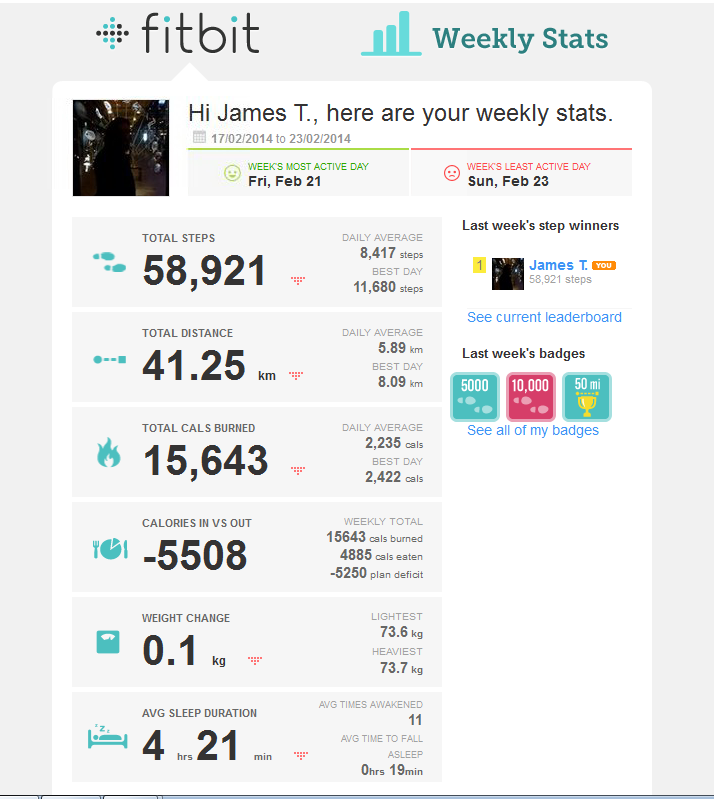
The automatic monitoring facilitated by my Fitbit flex and the Fitbit online dashboard application is delivering some really useful information. I'm trying to feedback this into my actions to improve my results through evaluation and tweaking (apply self-regulation and accept feedback). All of the stats above appear to be good renderings of reality, apart from...
- Calories In vs Out (the Calories In bit is not automated and requires me to enter all the food items I consume and record their nutritional information, this is not always easy to do, when I do it - and it's an area that I don't always do - it's easy to forget or overlook as it's time consuming and fiddly).
- Sleep Duration (the Fitbit records movement in my sleep as time awake, my subjective take is that it may well reflect restlessness but generally doesn't reflect a wakeful state)
The statistic I've observed most acutely has been daily Steps. The NHS Choices website states that: 'Research shows that walking 10,000 steps a day will
significantly improve your health. Putting one foot in front of the
other can build stamina, burn excess calories and give you a healthier
heart.' I've taken this as a good base peoplecare goal for fitness, to build subsequent exercise on. The Fitbit also includes a goal system, with 10,000 steps as the default - and seems to record steps accurately. The Fitbit dashboard records and reveals my sedentary existence, here's my steps from Monday 24th February:

The first rise at 7.30 am is me getting up, the first burst of yellow walking from home to the train station - then it flat lines again for my train journey, until more activity between 9 and 9.45 as I navigate from train to tube and then from the tube station to work. Then it's pretty flat again until about 1.45 pm when I go to lunch and walk around outside until 2.45 when I'm back at the desk. At 6pm I reverse my commute, with a last burst around 7.30pm as I walk from the train station to home. That day I walked a total of 8,528 steps a little above my weekly average of 8,417. Given how little I actually seem to move around, I was unsurprised that my average was below the recommended 10,000 - what did surprise me is that according to that NHS Choices piece 'The average person walks between 3,000 and 4,000 steps per day' - so what the hell are they doing all day? (driving door-to door to desk jobs I guess).
So, I've looked for some small and slow solutions to getting some more steps into my day. On weekdays I've got plenty of limiting factors to design around, these are my main boundary conditions:
- Hours I'm asleep: Wake up c.7.30 am, go to bed c.12am - 7 hour 30 mins a day.
- Hours I'm commuting: 3 hours a day
- Working hours: 8 hours 15 mins a day (including 1 hour lunch break)
- Meals: 3 meals a day at 30 mins each: 1 hour (1 at work accounted for above)
- Ablutions, dressing & undressing: 30 mins a day
Total of the above is 20 hours 20 mins - leaving me a resource of 3 hours 40 mins to get some more steps in (and do everything else I want to do in my life). If I eat my lunch in 30 minutes, I can add another 30 minutes as available time, giving a total time resource of: 4 hours 15 mins.
So where is this time:
2.15-2.45 - 30 mins
8.10-11.55 - 3 hours 45 mins
It's in my lunch hour at work and between eating dinner and going to bed at home. I'm aware that this picture is not completely accurate either, there are occluded factors:
- I'm already walking most of that 30 mins in my lunch hour, so it's 'available' but the steps are already recorded. (One lunchtime I stayed in (no walking about) I only did 6,500 steps)
- I don't eat dinner as soon as I get in, I may 'decompress' from my commute for 30 mins to 1 hour before eating.
- Dinner taking only 30 mins is dependent on my partner doing all the preparation and cooking which is inequitable (not a fair share of the work, and not good peoplecare for a relationship).
- Doing the washing-up is not accounted for.
- Sometimes I'm so knackered I go to bed at 10.30pm not 12 am.
- For a lot of the year (as now) this evening period is after dark, cold & not very inviting for walking in.
- My commute is subject to regular delays adding to my journey times.
- When I'm late for work as a result, I have to make the time up with a longer working day
Despite all this there are weekdays when I have walked in excess of 10,000 steps - including a'best day' of 11,295 (the 11,680 best day listed above was a Saturday). So what made those days different? I've identified three factors associates with weekdays I walked 10,000+ steps:
- Days I scoffed my lunch/eat while working and walked most of my lunch hour.
- Days I didn't go straight home, but stayed out and did stuff in London before going home.
- Days I went home - then went out to the shops and back for some necessary food item.
Actually those extra 1,500-2,000 steps don't take long to do - 1,000 steps is the equivalent of around 10 minutes of brisk walking - so I only need to find 15-20 minutes. It's tempting to try and fit this in in lunchtime, but I'm conscious that the repercussion is not very mindful eating - an undesireable outcome. The elephant is of course, that 10,000 steps is only a beginning - when can i fit in any other exercise on top of 10,000 steps?
I frequently go out walking during my lunch hour, generally following the same few routes. To make walking more interesting I think I need to mix it up a bit more. To find where I can get to in the time I have, requires a bit of survey and analysis. A local street map and knowing my walking pace provides survey data, analysis requires crunching these pieces of data. A useful visual presentation of this analysis is a different kind of map - an isochronic map. I'm fortunate that London is well supplied with ready-made isochronic maps for walkers, generated by the wonderful Legible London project - a pedestrian wayfinding system to help people walk around the capital. [I think this project is a triumph of design thinking, read about how it was developed in Legible London - a wayfinding study]. One of the Legible London isochronic walking maps is situated near to my workplace providing a good indication of the boundaries of where I could get to and back in 30 mins.

This Legible London is a great free resource, but is limited in a few ways:
- It only indicates a 15 minutes walk perimeter
- It cannot indicate the likely timing of any particular route through the 15 minute zone
So if I want to walk for longer than 30 minutes, or take a route other than from where I am to the perimeter and back I'm on my own with the details. A complementary source of isochronic mapping is the website Walkit. Walkit features an urban walking route planner (for London and several other UK cities) which can provide route maps between any two points, including the journey time, calorie burn, step count and carbon saving. It can also provide circular route maps based on walking pace and available time. Here's a route from and to my workplace taking c.1 hour at a 3mph walking pace:


Walkit has free and subscription options, the above route map was available free. Subscribers to walkit can generate 5 different circular walks, of the same length, from the same
point; generate an isochrone around any postcode in covered cities by time or distance' and a range of other benefits (£15 a year/£1.50 a month). I'm tempted by this extra functionality, but I'm also tight! - so I haven't signed up. In any case, common sense, existing knowledge of the city and experience as a walker provides me with heuristics to intuit my own isochrone. That said, just looking at and thinking about the Legible London and Walkit maps has improved my time sense of the landscape around where I work. Following Bart Anderson's re-interpretaion of permaculture zoning for urban areas, the walking isochrone represents the 'pedosphere' of Zone 1.

I am continuing to track, evaluate and tweak my path towards my weight-loss goal. Just altering my diet has proved quite successful so far, with a weight loss of 3.1kg since beginning in January. The rate of loss has slowed hoever, pointing towards the need for more physical activity.


I'm nearing the 'safe zone' of BMI, but still a way off my weight goal. Exercise is the clear tactic for increasing my liklihood of achieving this goal, but I need to find ways of designing this into my life in a sustainable way. Many comments on facebook below a post on my previous personal health blogpost, 'Fat is an Ecologist Issue', suggested exercise practice that worked for the commentators. My next step is to review these to see if they might work for me, and consider other ways to increase my activity level.

generate 5 different circular walks, of the same length, from the same point
Read more at https://walkit.com/circular-walks/#8fkCTOl8Id4kIXKJ.99
Read more at https://walkit.com/circular-walks/#8fkCTOl8Id4kIXKJ.99
route
map between any two points, including your journey time, calorie burn,
step count and carbon saving. It’s quick, free, healthy and green.
Read more at https://walkit.com/#HIF7X2E7VKZivdBP.99
Read more at https://walkit.com/#HIF7X2E7VKZivdBP.99
route
map between any two points, including your journey time, calorie burn,
step count and carbon saving. It’s quick, free, healthy and green.
Read more at https://walkit.com/#HIF7X2E7VKZivdBP.99
Read more at https://walkit.com/#HIF7X2E7VKZivdBP.99
route
map between any two points, including your journey time, calorie burn,
step count and carbon saving. It’s quick, free, healthy and green.
Read more at https://walkit.com/#HIF7X2E7VKZivdBP.99
Read more at https://walkit.com/#HIF7X2E7VKZivdBP.99
Friday, 7 February 2014
Fat is an Ecologist Issue
 |
| World Map according to Ecological Footprint |
Over Christmas I shaved my bush of a beard off. Family and workmates were shocked by my naked face, as I looked so different, I was shocked by an imminent double-chin and a certain pudge about the cheeks.I knew already that my life was pretty sedentary, that I love chocolate a little too much and that I was 'soft in the middle'. My face was a wake up call though, a message that it was time to do something about it. I don't want a fat face, I don't want a fat anything - I didn't like the way that I looked, this provided impetus to an initial goal formulation along the lines of 'I don't want to be fat'.
Alongside the personal appearance issue, was how fatness placed me in social and ecological terms - this fatness is a characteristic of the west, of the first world. I'm haunted by the idea that one billion of the population are overweight, while another billion go hungry. Visual fatness was a physical indicator that not only was I not demonstrating good people care to myself, I was also not taking a fair share and it was pretty clear where the surplus was being returned to. If I was eating more than I needed to, then I was probably increasing my food ecofootprint unnecessarily too, putting more of the earth's resources in the service of my appetites, not really earth care either. My body was becoming a visual synecdoche for the swollen Britain seen in World Mapper's ecological footprint map (above).
If was going to make an effective change to this knew I needed some baseline data to go alongside my 'eyeball survey'. I headed to a Boots ('the chemists') many of which have weighing machines, that will also calculate your BMI (Body Mass Index) and the percentage of your body that is 'fat'. The data was a bit shocking and made me feel more motivated to change, now I had some numbers:

- Heart disease
- High blood pressure
- Diabetes
- Arthritis
- Infertility
- Asthma
- Cancer
- Alzheimer's(?)*
Addressing the input part of the equation means looking at diet and the food that goes in. I hadn't done a detailed survey of what I was eating, but I already had a gut feeling that my enjoyment of such healthy foodstuffs as crisps, dark chocolate, milk chocolate, cakes, chocolate, donuts, chocolate, beer, chocolate, chips, chocolate etc, probably wasn't helping. Looking at the cold stats behind my belly I finally felt the pain in pain au chocolat.
Addressing the output part of the equation was less about liquid gold and compost loos as it was about activity levels - 'work', basic metabolism - brain/organ function, and heat. As I work a 9.45-6 day, Monday-Friday week sat largely at an office desk, with a 3 hour daily commute say mostly on a train - my life may be safely considered sedentary: low activity level.
So a shorthand for looking at inputs and outputs is diet and exercise.
I felt that there was too much confusion about what constitutes a good diet to spend too much time surveying it, I decided to just change my diet and monitor how that went, adjusting it to the feedback/ information I received and learning along the way. Somewhat randomly I chose a (s)low carb approach, based on an avoidance of sugary and simple carbohydrate foods (my nemesis) in favour of a more protein orientated diet, combing this with a one-day a week off-day (Saturday for me) following a suggested diet by Tim Ferris. I felt the 'off-day' acknowledged the common dieting pattern of recidivism by capturing it as a controlled habit included within the diet, removing guilt, increasing the likelihood of maintaining new behaviours: the problem is the solution. Weekly monitoring of my stats would allow me to follow how effective this would be.
On the output side I similarly did not want to join the January rush to the gyms a pattern that is often quickly followed by another: people stop going to the gym. Instead I turned again to monitoring, this time measuring my activity levels. To assist this I decided to make use of some personal technology, purchasing a fitness tracking device (Fitbit Flex) that would automatically gather data and present it into a web form. While buying a piece of technology involved indulgence in consumer culture, I decided that the benefit of an automated process not dependent on personal memory and notation would be likely to make my monitoring more accurate and effective.
 |
| [See live-ish results on profile at: https://www.fitbit.com/user/2D9LVR] |
I hope that this information will allow me to better evaluate and tweak my personal health design, through a constant state of survey and analysis within which I apply self-regulation and accept feedback as I discover what works for me as I move towards my goals.
That initial Boots weighing machine result has helped me to define those goals in a SMART form:
- Specific: I want to get my BMI in the 'ideal range' by reducing my weight to 60kg (a 16.6kg reduction); and I want to get my body fat percentage in the 'good band'
- Measureable: by reducing my weight to 60kg (a 16.6kg reduction) and reducing my body fat percentage to c.23.5%.
- Achievable: I believe this reduction is realistic and attainable.
- Relevant: These are goals important to me and essential to maintaining good personal health.
- Timebound: I want to achieve these reductions within 6 months, i.e. by 1st July 2014.
* A major health concern for me is Alzheimer's Disease. My mum is suffering from the disease and may be an early onset case, her father also suffered from the disease and I learnt recently from my aunt that his father 'went a bit mad at the end'. Medical knowledge about the genetic component of Alzheimer's remains in its infancy at present, but my personal family history appears to indicate some risk. Most early-onset Alzheimer's disease cases are inherited ('early-onset' is where the disease occurs in people age 30 to 60), but my Mum's condition began to become evident around reaching 60 placing her on the cusp of early and late onset. Researchers have not yet found a specific gene that causes the late-onset form of the disease, although there are some genetic risk factors that appear to increase a person's risk of developing the disease. The non-genetic factors which lead some individuals to contract the disease and not others are also unclear, but I have become increasingly convinced by the hypothesis that there is a connection between Alzheimer's and type 2 diabetes conditions. If this is the case, then being overweight may also be an contributing factor to a condition which I may already have genetic pre-disposition towards.
Thursday, 6 February 2014

Subscribe to:
Posts (Atom)