At the recent Permaculture National Diploma Gathering, I was one of those asked the question:
What is permaculture?
Showing posts with label Permaculture. Show all posts
Showing posts with label Permaculture. Show all posts
Thursday, 11 December 2014

Saturday, 5 July 2014
Wednesday, 26 February 2014
Fitness: Stats February 2014
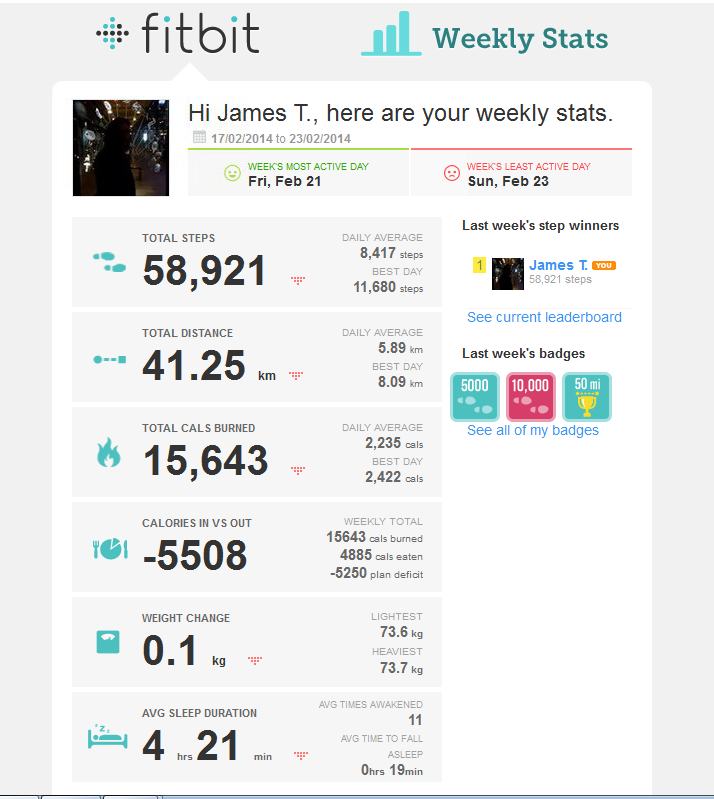
The automatic monitoring facilitated by my Fitbit flex and the Fitbit online dashboard application is delivering some really useful information. I'm trying to feedback this into my actions to improve my results through evaluation and tweaking (apply self-regulation and accept feedback). All of the stats above appear to be good renderings of reality, apart from...
- Calories In vs Out (the Calories In bit is not automated and requires me to enter all the food items I consume and record their nutritional information, this is not always easy to do, when I do it - and it's an area that I don't always do - it's easy to forget or overlook as it's time consuming and fiddly).
- Sleep Duration (the Fitbit records movement in my sleep as time awake, my subjective take is that it may well reflect restlessness but generally doesn't reflect a wakeful state)
The statistic I've observed most acutely has been daily Steps. The NHS Choices website states that: 'Research shows that walking 10,000 steps a day will
significantly improve your health. Putting one foot in front of the
other can build stamina, burn excess calories and give you a healthier
heart.' I've taken this as a good base peoplecare goal for fitness, to build subsequent exercise on. The Fitbit also includes a goal system, with 10,000 steps as the default - and seems to record steps accurately. The Fitbit dashboard records and reveals my sedentary existence, here's my steps from Monday 24th February:

The first rise at 7.30 am is me getting up, the first burst of yellow walking from home to the train station - then it flat lines again for my train journey, until more activity between 9 and 9.45 as I navigate from train to tube and then from the tube station to work. Then it's pretty flat again until about 1.45 pm when I go to lunch and walk around outside until 2.45 when I'm back at the desk. At 6pm I reverse my commute, with a last burst around 7.30pm as I walk from the train station to home. That day I walked a total of 8,528 steps a little above my weekly average of 8,417. Given how little I actually seem to move around, I was unsurprised that my average was below the recommended 10,000 - what did surprise me is that according to that NHS Choices piece 'The average person walks between 3,000 and 4,000 steps per day' - so what the hell are they doing all day? (driving door-to door to desk jobs I guess).
So, I've looked for some small and slow solutions to getting some more steps into my day. On weekdays I've got plenty of limiting factors to design around, these are my main boundary conditions:
- Hours I'm asleep: Wake up c.7.30 am, go to bed c.12am - 7 hour 30 mins a day.
- Hours I'm commuting: 3 hours a day
- Working hours: 8 hours 15 mins a day (including 1 hour lunch break)
- Meals: 3 meals a day at 30 mins each: 1 hour (1 at work accounted for above)
- Ablutions, dressing & undressing: 30 mins a day
Total of the above is 20 hours 20 mins - leaving me a resource of 3 hours 40 mins to get some more steps in (and do everything else I want to do in my life). If I eat my lunch in 30 minutes, I can add another 30 minutes as available time, giving a total time resource of: 4 hours 15 mins.
So where is this time:
2.15-2.45 - 30 mins
8.10-11.55 - 3 hours 45 mins
It's in my lunch hour at work and between eating dinner and going to bed at home. I'm aware that this picture is not completely accurate either, there are occluded factors:
- I'm already walking most of that 30 mins in my lunch hour, so it's 'available' but the steps are already recorded. (One lunchtime I stayed in (no walking about) I only did 6,500 steps)
- I don't eat dinner as soon as I get in, I may 'decompress' from my commute for 30 mins to 1 hour before eating.
- Dinner taking only 30 mins is dependent on my partner doing all the preparation and cooking which is inequitable (not a fair share of the work, and not good peoplecare for a relationship).
- Doing the washing-up is not accounted for.
- Sometimes I'm so knackered I go to bed at 10.30pm not 12 am.
- For a lot of the year (as now) this evening period is after dark, cold & not very inviting for walking in.
- My commute is subject to regular delays adding to my journey times.
- When I'm late for work as a result, I have to make the time up with a longer working day
Despite all this there are weekdays when I have walked in excess of 10,000 steps - including a'best day' of 11,295 (the 11,680 best day listed above was a Saturday). So what made those days different? I've identified three factors associates with weekdays I walked 10,000+ steps:
- Days I scoffed my lunch/eat while working and walked most of my lunch hour.
- Days I didn't go straight home, but stayed out and did stuff in London before going home.
- Days I went home - then went out to the shops and back for some necessary food item.
Actually those extra 1,500-2,000 steps don't take long to do - 1,000 steps is the equivalent of around 10 minutes of brisk walking - so I only need to find 15-20 minutes. It's tempting to try and fit this in in lunchtime, but I'm conscious that the repercussion is not very mindful eating - an undesireable outcome. The elephant is of course, that 10,000 steps is only a beginning - when can i fit in any other exercise on top of 10,000 steps?
I frequently go out walking during my lunch hour, generally following the same few routes. To make walking more interesting I think I need to mix it up a bit more. To find where I can get to in the time I have, requires a bit of survey and analysis. A local street map and knowing my walking pace provides survey data, analysis requires crunching these pieces of data. A useful visual presentation of this analysis is a different kind of map - an isochronic map. I'm fortunate that London is well supplied with ready-made isochronic maps for walkers, generated by the wonderful Legible London project - a pedestrian wayfinding system to help people walk around the capital. [I think this project is a triumph of design thinking, read about how it was developed in Legible London - a wayfinding study]. One of the Legible London isochronic walking maps is situated near to my workplace providing a good indication of the boundaries of where I could get to and back in 30 mins.

This Legible London is a great free resource, but is limited in a few ways:
- It only indicates a 15 minutes walk perimeter
- It cannot indicate the likely timing of any particular route through the 15 minute zone
So if I want to walk for longer than 30 minutes, or take a route other than from where I am to the perimeter and back I'm on my own with the details. A complementary source of isochronic mapping is the website Walkit. Walkit features an urban walking route planner (for London and several other UK cities) which can provide route maps between any two points, including the journey time, calorie burn, step count and carbon saving. It can also provide circular route maps based on walking pace and available time. Here's a route from and to my workplace taking c.1 hour at a 3mph walking pace:


Walkit has free and subscription options, the above route map was available free. Subscribers to walkit can generate 5 different circular walks, of the same length, from the same
point; generate an isochrone around any postcode in covered cities by time or distance' and a range of other benefits (£15 a year/£1.50 a month). I'm tempted by this extra functionality, but I'm also tight! - so I haven't signed up. In any case, common sense, existing knowledge of the city and experience as a walker provides me with heuristics to intuit my own isochrone. That said, just looking at and thinking about the Legible London and Walkit maps has improved my time sense of the landscape around where I work. Following Bart Anderson's re-interpretaion of permaculture zoning for urban areas, the walking isochrone represents the 'pedosphere' of Zone 1.

I am continuing to track, evaluate and tweak my path towards my weight-loss goal. Just altering my diet has proved quite successful so far, with a weight loss of 3.1kg since beginning in January. The rate of loss has slowed hoever, pointing towards the need for more physical activity.


I'm nearing the 'safe zone' of BMI, but still a way off my weight goal. Exercise is the clear tactic for increasing my liklihood of achieving this goal, but I need to find ways of designing this into my life in a sustainable way. Many comments on facebook below a post on my previous personal health blogpost, 'Fat is an Ecologist Issue', suggested exercise practice that worked for the commentators. My next step is to review these to see if they might work for me, and consider other ways to increase my activity level.

generate 5 different circular walks, of the same length, from the same point
Read more at https://walkit.com/circular-walks/#8fkCTOl8Id4kIXKJ.99
Read more at https://walkit.com/circular-walks/#8fkCTOl8Id4kIXKJ.99
route
map between any two points, including your journey time, calorie burn,
step count and carbon saving. It’s quick, free, healthy and green.
Read more at https://walkit.com/#HIF7X2E7VKZivdBP.99
Read more at https://walkit.com/#HIF7X2E7VKZivdBP.99
route
map between any two points, including your journey time, calorie burn,
step count and carbon saving. It’s quick, free, healthy and green.
Read more at https://walkit.com/#HIF7X2E7VKZivdBP.99
Read more at https://walkit.com/#HIF7X2E7VKZivdBP.99
route
map between any two points, including your journey time, calorie burn,
step count and carbon saving. It’s quick, free, healthy and green.
Read more at https://walkit.com/#HIF7X2E7VKZivdBP.99
Read more at https://walkit.com/#HIF7X2E7VKZivdBP.99
Thursday, 20 February 2014
Permaculture is [not] a Cult
 |
| Rare picture of Bill Mollison presenting certificates at the end of one of the first Permaculture Design Courses |
Because a particular sequence of four letters are discernible in the word permaCULTure, it is an easy jibe to suggest that permaculture is a cult (presumably alongside other cultic movements such as agriCULTure, hortiCULTure, vitiCULTure, monoCULTure etc). Some critics meanwhile, while alive to this wordplay potential, have also presented a wider case for considering permaculture as a cult. In his article 'Permaculture: The Big Rock Candy Mountain' originally published as 'A Critique of Permaculture; Cleaning out the stables' in Permaculture Magazine (1997), reprinted by the Centre for Alternative Technology in 2003 and more recently republished in The Land, Issue 14, Summer 2013 Harper presents two strands of permaculture - 'Smart' and 'Cult'.

 |
| The prophet Holmgren, awkward purveyor of metaphysics, biodynamics and Mother Earth religion |
Graham Strouts's article 'The Cult of Perma' builds on Harper's article with a more strident attack on permaculture. He agrees with Harper that 'there are many permacultures' but is 'personally skeptical that the “smart” permaculture exists at all'. In fact he argues that 'it is inescapable that permaculture as a political movement fits snugly
alongside broader conservative environmentalism, with its mixture of
elitist traditionalism and eco-fascism, closely associated with New Age
spirituality, anti-science and pseudo-science, the quackery of the
Organics movement and “alternative” therapies, middle-class health-food
obsessions and quasi-religious misanthropic convictions about the purity
of Nature and the Fallen-ness of Mankind.' He concludes that 'At the end of the day though, once you strip away the pseudo-science,
the Sky-is-Falling doomerism and the feel-good idealism of living in
barefoot communes and growing your own food... all you are left with is the Cult of Perma.' It's difficult to determine the exact characteristics of permaculture which Strouts identifies as cultish. There are several pointers towards what he perceives as a religious sensibility within permaculture. He points to an earlier article in which he finds permaculture co-originator David Holmgren to be 'the awkward purveyor of metaphysics, biodynamics and Mother Earth religion' (I find this article's analysis of Holmgren's writing in Permaculture; Principles and Pathways Beyond Sustainability to be an attempt to simplify Holmgren's measured and carefully chosen words into a blunter form something of a straw man argument, but I invite readers to draw their own conclusions). He asserts that permaculture 'attracts a middle-class hippy-peasant chic' which finds 'meeting physical needs... as somehow dirty and base compared with
narcissistic aspirations of spiritual purity and “well-being”.' He further finds that 'many of the movement’s leading figures themselves seem influenced by pseudoscience'. Despite the use of the word 'cult' there does not seem to be a strong attempt to identify particular cult qualities, the word seems to be mainly used as a derogatory shorthand. The closest Strouts argument gets to actually proposing permaculture is a cult is by associating it with anthroposophy and an amorphously described 'mother earth religion' - with the implication that these are cults: therefore permaculture is as a cult, which even if we agree that these other organisations are cults, and that some permaculturalists are also engaged with them would seem to be a syllogistic fallacy and guilt by association. A subsequent article by Strouts, 'Feedback on the Cult of Perma', repeats the assertion that permaculture is a cult. After quoting Toby Hemenway suggesting permaculture is not a science but a 'design approach' for finding solutions to most problems, Strouts adds ' “Cult” flashes large in my minds’ eye when I hear such grandiose claims-
this is surely a self-fulfilling prophecy in which any “solution” (as
if we can even agree on what constitutes such) to any problem can be retrospectively identified as being “permaculture”.'He concludes the article with a reflection that permaculture's ethics of earth care and people care are essentially in irreconcilable opposition, that permaculture co-originator Bill Mollison believes humanity is in overshoot and therefore favours earth over people, that the permaculture community never discusses this, thus 'permaculture will remain a misanthropic cult.'
How might we analyse whether, or to what degree, permaculture exhibits cult dynamics - how can we discern whether the suggestion that permaculture is a cult is true? First we must turn to the meaning and definition of the word 'cult'.
The resonance of the words ‘cult’ and ‘culture’ which affords
such self-satisfied wordplay by permaculture detractors is of course not
accidental. Both have their origin in the Latin word cultus – ‘to tend, take care of, cultivate’
which originally meant ‘to dwell in or inhabit’. Thus agriculture means to tend or cultivate land
(ager). The broader modern concept
of culture originates with the concept of cultura animi or
cultivation of the soul. The non-agricultural use of the term culture re-appeared during the Enlightenment referring to the betterment or refinement of individuals,
especially through education. During the 18th and 19th century it came to refer
more frequently to the common reference points of whole peoples, and discussion
of the term was often connected to national aspirations or ideals. Meanwhile religion
was cultus deorum, ‘the cultivation of the gods’ and the
cultivation necessary to maintain a specific deity was that god's cultus or ‘cult’. The word ‘cult’ entered
English from the French in the 1600s meaning worship (which in France it still
does); by the nineteenth century it had broadened in meaning to signify ‘devotion
to a person or thing’.
The derogatory use of the word ‘cult’ in the modern sense appears
to be a product of the late nineteenth century when it gained the connotation of 'a relatively small group of people having (esp.
religious) beliefs or practices regarded by others as strange or
sinister, or as exercising excessive control over members' (OED). A familiar reference point is probably the religious groups of the 1960s/1970s counterCULTure, with the diabolical extreme of outfits led by the likes of Charles Manson and Rev. Jim Jones et al providing iconic examples and a wealth of less deadly 'new religious movement' groups like the Moonies, the Jesus Army, Scientology and the Children of God providing further colour. I think it is safe to assume that it is something of this flavour of cults that is being alluded to - with Strouts also pointing to a longer tradition of nature mysticism. All this is interesting, but leaves open how we establish the existence of cult dynamics.
 |
| The International Permaculture Convergence in Cuba, 2013 |
- The group displays excessively zealous and unquestioning commitment to its leader and (whether he is alive or dead) regards his belief system, ideology, and practices as the Truth, as law.
- Questioning, doubt, and dissent are discouraged or even punished.
- Mind-altering practices (such as meditation, chanting, speaking in tongues, denunciation sessions, and debilitating work routines) are used in excess and serve to suppress doubts about the group and its leader(s).
- The leadership dictates, sometimes in great detail, how members should think, act, and feel (for example, members must get permission to date, change jobs, marry—or leaders prescribe what types of clothes to wear, where to live, whether or not to have children, how to discipline children, and so forth).
- The group is elitist, claiming a special, exalted status for itself, its leader(s) and members (for example, the leader is considered the Messiah, a special being, an avatar—or the group and/or the leader is on a special mission to save humanity).
- The group has a polarized us-versus-them mentality, which may cause conflict with the wider society.
- The leader is not accountable to any authorities (unlike, for example, teachers, military commanders or ministers, priests, monks, and rabbis of mainstream religious denominations).
- The group teaches or implies that its supposedly exalted ends justify whatever means it deems necessary. This may result in members' participating in behaviors or activities they would have considered reprehensible or unethical before joining the group (for example, lying to family or friends, or collecting money for bogus charities).
- The leadership induces feelings of shame and/or guilt in order to influence and/or control members. Often, this is done through peer pressure and subtle forms of persuasion.
- Subservience to the leader or group requires members to cut ties with family and friends, and radically alter the personal goals and activities they had before joining the group.
- The group is preoccupied with bringing in new members.
- The group is preoccupied with making money.
- Members are expected to devote inordinate amounts of time to the group and group-related activities.
- Members are encouraged or required to live and/or socialize only with other group members.
- The most loyal members (the “true believers”) feel there can be no life outside the context of the group. They believe there is no other way to be, and often fear reprisals to themselves or others if they leave (or even consider leaving) the group.
We can use these as a checklist both for mapping characteristics identified by Harper and Strouts, and as an indicator of cultic dimensions within permaculture.
What stands out immediatley when considering the ICSA list is the language of 'leader', 'leadership', 'group' and 'members' which seems to bear little relationship to what I see in permaculture. Harper notes 'heroes' under both 'smart' and 'cult' permaculture, but no leadership role is implied in his use. The individuals listed amongst these 'heroes' are certainly significant figures in the development of permaculture (although the list is probably more pertinent to its initial publication date in 1997 than today) but even those still living are not commonly understood as 'leaders' of permaculture. Some permaculturalists seem overly fond of being 'Mollisonist', but they would be hard pressed to discover any dictates uttered by him in the last decade. Mollison's 'prime directive' of permaculture is 'The only ethical decision is to take responsibility for our own existence and that of our children.' which seems quite distant from the idea of a leader dictating how people should 'think, act and feel'
Bill Mollison's Permaculture; A Designer's Manual, Mollison and David Holmgren's Permaculture One, Robert Hart's Forest Gardening and Masonobu Fukuoka's One Straw Revolution, are in Harper's phrase, 'founding texts' of permaculture from which basic ideas have been drawn. Few of those involved in permaculture will have read all of them though (or indeed any of them), so while they may reflect the belief systems, ideology, and practices of leading figures (not 'leaders'), there is enthusiasm but not not zealous and unquestioning commitment to those beliefs, ideologies and practices. There is nobody in a role to punish or discourage questioning, doubt, and dissent - in fact permaculture principles encourage using and valuing diversity and valuing the marginal - ideas which counter centralising, hierarchical approaches.
The arguments against permaculture by Harper, Strouts and others may contain other critique worthy of exploration, I'll take a look at that separately, but the use of the word 'cult' appears to just be name-calling - at best loose thinking, and at worst a bit of propaganda to tip cognitive bias without supporting evidence. It's loaded language, a snarl word designed to illicit negative reactions in the reader. The identification of the word part ‘cult’ within permaCULTure is largely equivocation – misinterpreting the intended meaning in order to support an argument, yet on a deeper level it does highlight the necessity of active care taking within a movement for sustainability, a vocation which will no doubt supply spiritual satisfiers for many participants - whether that movement is religious or not.
Tuesday, 14 January 2014
Underneath the Bunting at the Potluck Supper

I think that it might be difficult to find a common position that contains the diverse opinions of the trustees, let alone the membership we represent, so I can’t personally see at present that our steer should be more than a reminder to use and value diversity. I posted the original article and responses in the Facebook group but initially stayed out of the discussion afterwards, feeling that all the articles had their particular merits. Then someone posted this quote from Bill Mollison in Introduction to Permaculture:
“The greatest change we need to make is from consumption to production, even if on a small scale, in our own gardens. If only 10% of us do this, there is enough for everyone. Hence the futility of revolutionaries who have no gardens, who depend on the very system they attack, and who produce words and bullets, not food and shelter.”
To which I felt compelled to reply:
“I guess we keep going back to who that 'us' is, of which 10% is enough. Mind you, I always take Mollison's statistics with a pinch of salt - he talks a good talk. I don't know when Mollison wrote or said that - most of his public comments come from the 1980s and early 1990s. Given the growth of permaculture & similar activities since, I imagine that a number of people greater than the 10% of 'us' he was referring to then probably have produced at least on a small-scale in their gardens. Is there any more 'enough for everyone' than there was then because of it? I guess this is a reason why RH looks toward outreach, engagement and scalability through Transition points and perhaps why he questions Holmgren's unsourced throwing about of numbers.”
That seemed to be taking more of a ‘Hopkins line’ than I felt, but it took another comment to bring that out. Some one else noted that:
“I do not want a future where small % of the population plot to throw the rest into turmoil, I want a future where everyone is empowered to join in and make their difference and to help take society forwards. Planning to crash the system doesnt fit well with the kind of world and attitude I want to create. As Rob says, it’s not very 'people care'
For some reason that provoked me into some more thoughts on the issue, which follow:

Holmgren’s strategy is basically [as he acknowledges] a version of the well-worn economic-boycott, which previous social movements have used to influence systems perceived as destructive of human and/or natural capital: such as economic boycotts of South Africa, Israel, Nestle, Coca Cola etc. Withdrawal of economic relations with these nation states or corporations is designed to have negative consequences for those boycotted, through consumers providing negative feedback – placing a financial capital cost on abuse of human/natural capitals. If the boycotted actors do not respond by ending their abuse of human/natural capitals, they incur the financial capital costs, which may lead to other consequences such as employees losing their jobs and personal financial security through redundancy. This means an action to try and end human rights abuses through an economic boycott, might involve some harm to people through bring economic turmoil to their lives. Nevertheless, if the harm to people effected by the continuing business-as-usual of an actor is significantly greater than the harm to people effected by crashing that business-as-usual – e.g. boycotting South African businesses and products, leading to job losses in order to catalyse the end of apartheid – then the strategy might still be considered an ethical response reflecting people care and fair share.
The Holmgren ‘plot’ (I use quotes as the conventional definition of plot is a plan made in secret by a group of people to do something illegal or harmful – and this is a public proposal not a secret plan, not illegal and questionably harmful) is: ‘behaviour change from dependent consumers to responsible self-reliant producers’ with the intent of ‘reducing consumption and capital enough to trigger a crash of the fragile global financial system’.
I understand the ‘global financial system’ to represent business-as-usual: growth focused economics, based on ever increasing over-exploitation of the Earth’s resources, with evident consequences including dangerous carbon emissions, nose-diving biodiversity, acidification of the oceans, massive wealth disparities, declining amounts of freshwater, topsoil, forests, wetlands, coral reefs etc. Natural capital is already failing suddenly (crashing) – business-as-usual has triggered a crash. Everyday it gets worse. If we agree that this is the case, then we should be explicit that we do not want business to carry on as usual leaving us with three main options: trying to adapt the status quo situation to a sustainable alternative over time, trying to end the status quo situation as quickly as possible, doing nothing.
‘Doing nothing’ is implicit support for business-as-usual and therefore untenable. Trying to adapt the status quo situation to a sustainable alternative over time is the strategy of ‘transition’ – it is based on the incremental approach, it is designed to be inclusive, to take as long as it takes and to lead towards designing and implementing a plan for energy descent. Many Transition groups are in their early stages, others are more progressed and no doubt have had some success in their locality. Meanwhile everyday carbon emissions, biodiversity figures, ocean acidity, wealth disparity, and the amounts of freshwater, topsoil, forests, wetlands, coral reefs etc. have got worse. As Rob Hopkins notes in ‘the economies where emissions are actually growing’ like China and India ‘the kind of 'post-materialists' who in Western economies might pioneer … [a] "crash on demand" hardly exist’, it might be fair to conclude therefore that the kind of ‘post-materialists’ who might pioneer Transition do not exist in those ‘economies where emissions are actually growing’ either. In fact, this tends to highlight that in terms of tactics there is not a lot of difference between Transition and ‘Crash on Demand’ – both focus on the household and local community levels as loci of action, both hope for a ripple effect from action on these levels by dispersed concerned individuals across the world, both think we should start right now if we haven’t already started, both promote actions which are worth doing anyway, both know that the success of their approach is not guaranteed.
The point of contention commonly found with Holmgren’s proposal appears to largely be a matter of marketing. Rob Hopkins has long held that the ‘key to our success will be our ability to generate positive visions of future, to harness the power of engaged optimism’, similarly in Nicole Foss’s response to Holmgren she writes ‘Permaculture has a very positive image as a solution to the need for perpetual growth, and this might be put at risk if it became associated with any deliberate attempt to cause system failure.’
If the success of Transition and/or permaculture is predicated on how well it “plays with the masses” or ‘speak[s] beyond the People Like Us’ – does it have to hide genuine desires and need for deep systemic change? If we believe that business-as-usual is killing the planet and that swift action is necessary to stop it, is it either ethical or effective to hide that away underneath the bunting at the potluck supper?
I'll give the last word to Jamie Saunders:
'Design/Plan for the best, prepare for the worst... with spread-betting for robustness, resilience, durability and 'stability'/viability'... not either/or, and/both as 'the future is unwritten'... '
Saturday, 28 December 2013
Travel (for pleasure)
 |
| Camp for Climate Action - Heathrow August 2007 |
Like
many people I love travelling for
pleasure. I am aware however of the environmental impact of travel,
especially over long distances.I love aeroplane travel, in my life I have been fortunate enough to
visit North America on three occasions, to see Japan and to take
holidays in many European countries. I love the magical thrill of
soaring into the sky, the incredible vantage point on the Earth an
aeroplane window provides and the wonder of stepping out into a foreign
climate mere hours from one's departure, the marvel of having the entire
world available for exploration.
In the mid-2000s however I realised that aeroplane travel as it exists today is unsustainable and cannot continue. According to the Environmental Transport Association a return trip by plane from London to New York produces about 1.2 tonnes of CO2 - roughly equivalent to the total emissions allowable if we are to stay within a fair share of the world's total safe emissions. If I genuinely wanted to demonstrate earthcare, I needed to recognize these limits and take responsibility for my own actions. I could no longer justify flying.
My first temptation to renege on my convictions came in 2005 when after a relationship failed, friends of mine invited me to holiday with them in Barcelona. I failed to resist, I let myself down and I flew. The decision haunted me though, and on the flight home I made a concious effort to stay present with the experience - enjoying all its nuances as I made a deepened my conviction to not fly again.
Since then I have faced more temptations to fly again, from the casual appeal of a quick trip to the heat of the Mediterranean, to offers of a free holiday in the USA and a work trip to Mumbai and the chance to visit India, a country that has long appealed to me. I have resisted them all but at the same time I have been determined to find other ways of meeting my yearnings to travel and, treating the problem as the solution, investigating other ways of travelling.

In December 2009 Claire and I travelled to Copenhagen to protest at the COP via train and ferry.

In October 2010 we went to Jordan by train, ferry, bus, taxi and boat.
In 2013 and 2014 we holidayed in France, travelling there and back by train.
Subscribe to:
Posts (Atom)